Headlines from First Thoughts

Wednesday, November 22, 2006

Thanksgiving for a Churchman

On Saturday, Kelly, Parker, and I gathered in Owensboro, Kentucky, to pay tribute to her grandfather. We will miss him at Thanksgiving this year. He never met a meal he didn’t like and as he wiped the last crumbs from his mouth, he always said, “This is the best meal I ever had.” That kind of statement typified a life of giving and gratitude.

We said goodbye to a true churchman. He chaired every building committee, capital campaign, deacon council, search committee, and group at Far Hills Baptist in Kettering, Ohio. If I know anything about building chairmen and capital campaign chairmen, he was also the first to give his offering—sacrificially—so that others will be inspired to give. He made sure the family was in church and stayed on them to remain involved in church. He’s the only person I know that when he moved closer to his daughter’s family and joined First Baptist Owensboro, they made him a deacon and soon thereafter a deacon emeritus.

He was man enough to cry at the drop of a hat and give hugs to anyone who tried to date their way into the family. In Grandaddy’s mind, you didn’t have to earn your way into the clan.

He was an avid reader of this newsletter and quite a student of worship. He would show me the worship guide from his church, discuss our bulletin with me, and ask probing questions. He was genuinely interested, not in a critical way, but so that he could learn even more about his own life of faith.

When I was in high school, I was naïve enough to think that churches just happen. The formula was simple: get the WMU, the prayer room, the youth group, Sunday School, and the Choir moving in the same direction, and you’ve got a great church. But churches don’t just happen. People like Frank Parks happen to join the cause because they care so much about Jesus that they want their church to live like Christ.

Albert Schweitzer remarked, “The great secret of success is to go through life as a man who never gets used up.” Frank forgot more about church life than most people ever knew. And my guess is we’ll still be telling several more Frank stories for years to come—stories about meals, and church, and family. And it will be the best advice we’ve ever had.

Saturday, September 30, 2006

In Memory of Ruth Ann Foster


Ruth Ann Foster, one of the founding faculty of Baylor's Truett Seminary, died Thursday after a long bout with cancer. I was her first student grader at Truett. A few reflections on a professor-friend....

When I first met Ruth Ann Foster, I was sitting in Christian Scriptures 1, trying to decide what the name "Christian Scriptures" meant, and asking myself, "Why didn't they just call this class 'Old Testament'?" On the first day of class, she announced that we would write 7 exegetical papers in one semester. After all, this was Truett Seminary, not that other one. A couple of days later, one of our fellow students evened the score by embarrasing her at El Chico in front of our Dean, Robert Sloan. It was the beginning of a long friendship of laughter and scholarship.

We became friends, not because of anything I did; but I think she and I could relate to one another. We were both non-Texans. Both of us attended fundamentalist schools in the past, and both were just grateful to be in Waco instead of Fort Worth. I married a girl from Ruth Ann's home state of Kentucky. Kelly and Ruth Ann shared a love of Kentucky basketball.

Ruth Ann helped me continue to unbox and bless my past and figure out how to use it in the future. She asked me to be her grader, and she put up with my bad habit of leaving every file drawer open at her desk. I tolerated her "office" (really a cubicle) that she kept a minimum of -32 or as low as the First Baptist Waco air conditioner would let her. I think Nancy de-Claisse Walford, who shared the other side of the office, wrote her dissertation in about 9 months just to keep warm.

More than anything, Ruth Ann was our pastor when I was in seminary. When the other professors took interims and preached on Sundays, Ruth Ann preached and pastored the students. She did not need a pulpit; she used her desk and her classroom to exhort us in our callings. Yes, she could hold her own against every Calvinist, closed minded, anti-women-in-ministry student she taught. But she handled every confrontation the way Bonhoeffer prescribed in Life Together, with honesty, grace, poise, and candor. And she showed each student how to disagree and still remain friends with some of the very people with whom she debated.

She helped us create the Truett Community. When the administration handed down another change, Ruth Ann kept us going. When Conyers couldn't find the right room, Ruth Ann laughed right along with us. When none of us liked the covenant groups, Ruth Ann let down her guard and was transparent enough to be a part of the groups. When students had problems, Ruth Ann hid her own private pain and showed up every time she could, even though she didn't feel like it.

Quietly behind her has been her mother Alice who played the best piano in Kentucky or Texas if you pressed her. She has cared for and loved on Ruth Ann and on every student that has walked into her home and helped them change a light bulb.

Sloan, Creed, Conyers, Foster, Dilday, Houser, deClaisse-Walford, Harbour-- all of them arrived in 1994; and all have a very significant place in my heart and in the formation of Truett Seminary.

The glue that held us together was Ruth Ann Foster. She leaves a legacy that we should all emulate.

Monday, September 11, 2006

Sabbath Jars


Most people begin practicing Sabbath by trying to find a 24-hour slot. They schedule the time, try to take a break, and feel guilty about the laundry or the email for an entire week. That feels more like time management to me, not observing Sabbath. In the wilderness, the Israelites first practiced Sabbath by trusting that God would provide manna—twice as much before their day off, and the regular amount afterward. Sabbath begins with acknowledging God’s provision and trusting God during a day off.


Last Sunday, I shared ways that individuals and families can recognize that God will always supply their needs. I suggested following a method similar to the one in Exodus 16. Find a jar (or use the one given to children and youth), and fill it with symbols of the ways God has provided for you in the past. Focus on the intangible gifts: a picture of family, a timely email of encouragement, a token of laughter or love. Display the jar in your home; discuss it with roommates, friends, and family. Every time you see it, you’re preparing for Sabbath. You will know that God will take care of you before and after your day of rest.

As a church, we have a similar assignment. Last year, God demonstrated his provision tangibly through our pledges to the capital campaign. We used “Fulfilling the Promise” flower pots with prints of FBC children’s hands to decorate the breakfast that day. The flower pots are back; but this time, we don’t need pledge cards or balloons. I want to know other ways that God has provided for our church. We share a collective memory of several hundreds of years of service at 1B. How have you seen God provide? Drop something in the flower pot: a picture, a note, a memento. Note paper is provided nearby each flower pot; scribble a phrase or two and added to the soil. These pots are placed throughout the church.

The Sabbath Series ends October 1 with communion. On that day, people bring their jars of God’s provision to worship. We will also share the blessings of God’s provision that they have left in the “Fulfilling the Promise” pots. Every time we remember God’s provision, we celebrate Sabbath. Let’s remember for generations to come.

Monday, September 04, 2006

Sabbath Definitions

I'm preaching a series of messages on Sabbath over the next month. If you announce the topic of Sabbath, suddenly everyone has a definition.

I heard a few comments in the hallway Sunday:

“Dr. Shiell just gave everyone permission to sleep in church.”

“This means I get out of laundry and cooking today.”

“If we’re supposed to keep the Sabbath, where do I put it?”

Part of the fun of Sabbath is dusting off an old treasure, much like finding a gift in the attic left unopened for years. The other part comes in redefining what Sabbath means for our time and our generation. Each generation has had to do so. Much of the furor over the Sabbath in the Pentateuch began over adapting a commandment to a wilderness tribe. When Jesus arrived, the Pharisees were still trying to figure it out and missed the point entirely; and they did not care for his definition too much.

I can tell you what Sabbath is not. It’s not counting footsteps, passing more Blue Laws, or skipping movies. All those things limit the gift to a few simple things we can check off a list and say, “Ok! I got one out of 10 commands right.”

I can’t tell you how to define Sabbath personally. Church staff and others who work on Sunday know that Sabbath goes beyond one day of the week.

Part of the joy of rediscovery comes in studying the concept and redefining it. As you do, several themes of Sabbath should be remembered, observed, and practiced as you find the joy in the gift. (I reserve the right to add to these as we move through the series, and I welcome your additions and comments on these themes.)

Sabbath is a time.

Sabbath brings people together. From creation forward, Sabbath is about reuniting a community-- whether tribe, church, friends, or family.

Sabbath is different than the ordinary routine. We spend most of our time sleeping and working for pay; and if we don’t, someone is providing both for us. The Sabbath breaks whatever makes up the bumping, grinding, and draining parts of your life.

Sabbath points to eternity. One day a week reminds us that this is partly what heaven feels like.

Sabbath is stewardship. It says, “I know God will provide even if I take a break.”

Sabbath is generosity. It extends rest to those worn by the labors of life.

Sabbath is dependence. The world goes on without us because God is in charge.

Sabbath is more than a 24-hour period on a calendar; it’s a lifestyle of finding restful moments throughout the week.

According to Abraham Heschel, the rabbis described Sabbath as a man getting lost in the woods only to find a large palace in the middle of the forest. This month, in the thicket of your schedule, may you find a palace in time.

A Sabbath for Cal

Life in Knoxville after a football game is combination recovery, therapy (depending on the final score), post-game analysis, and victory party (again depending on the final score). When I planned to start a sermon series on Sabbath yesterday, I knew what I was getting into. Football and Sabbath don't mix. It's not very restful dealing with traffic congestion, pre and post game stress, and the reality that football like Sabbath rolls around every week. Sometimes several times a week. But I thought, "It's Labor Day weekend; what a better time to focus on this Gift from God."

The last thing I expected to see on Sunday after UT's route of Cal on the river was a Cal fan plunked right in the middle of the sanctuary for the first service. At first, I didn't recognize our blue-and-yellow-clad guest. He feverishly took notes during the sermon and found me in the library after the service. He identified himself and told me that he had flown in from Berkely for the game. He was very complimentary of the people and the warm welcome, but he especially liked the prayer before the football game. "We couldn't do that in California. The believers there just gather under the trees and pray before the game-- much like that prayer yesterday, for the important things. It's just football, you know."

It's just football. The guy on the losing end of Saturday just stole my sermon. On Sunday, the scoreboard doesn't matter. Even in the midst of the fun of cheering on a team, football needs a Sabbath. For one guy from Berkely, who hopped a plane to watch his team learn about life in the SEC, he found true rest. Thanks for the gift.

Saturday, August 26, 2006

Homework

Parker brought home his first homework assignment Friday. Kelly and I picked him up from school together. Friday was his first full day, and the teacher sent home some work to do. It's due Wednesday, but being the industrious Dad that I am, and knowing that Tuesday night could be torture trying to get it done, Parker and I worked on it together Friday afternoon.

Friday's assignment involved the alphabet. They're working on the letter M next week, so the assignment was of course about all things "M": Mommy, munching, M & Ms. You get the picture. The first assignment, however, was really not the homework. It was getting Dad to figure out the assignment. I leafed through the yellow folder that was supposed to contain the worksheet, read through the note to parents, and we began. Parker had an "M" sheet in his hand, complete with an "M" man to color; and I naturally assumed this was the homework sheet.

We began the process. We had to find magazines, tape, and scissors. He was supposed to (1) cut out "M" from magazines, both pictures of words starting with M and the letter itself, (2) paste them on the page, and (3) write his name. We assembled the old magazines we could find and started cutting. Watching Parker attempting this was a little bit like trying to get jello to stop moving. He was all over the place. In my lap, on the floor, looking around, asking for a break every 15 minutes.

About midway through the assignment, I continued reading through the yellow folder. There were other pages inside that contained notes to the parents. I happened upon another sheet that said, "Sample Letter Page" at the top. The sheet had examples of how to complete the assignment. I realized, "Parker's M page doesn't match the sample page in the folder." Even worse, I couldn't find a blank version of the sample page.

I pretended to urge Parker to continue but had this sinking feeling, "I've just caused my son to fail his first homework assignment. He's filled out the wrong homework page." After the 10th time looking feverishly through the folder, I found a blank page that matched the sample completed page.

"I think we were supposed to do that one," said Parker.

"Yes," I replied, trying not to admit a mistake and frustrate him even further, "We were just practicing on the other page. Now this one is for real."

When we finally completed the assignment we had two perfect homework pages, one exasperated Dad, and a reminder that life could be easier if you had all the instructions in front of you at the start. You can't read a book, a homework assignment, a Bible or even a life by just taking one part at a time. You need to see the big picture to understand the concept. That's the kind of work that I need at home.

Friday, August 18, 2006

Great


Parker described his first day at school in one word: "GREAT!" Since he has never attached this adjective to anything, I think we've found a winner.

The morning started early for yours truly. I woke up at 5:00 a.m. ready for the new day. I felt like it was my first day. I aroused the young scholar around 6:20, to which he promptly responded, "It can't be morning already!" After shaking off the cobwebs, we were off and rolling. Kelly and I rode together for the inaugural day. We parked, snapped a few photos, and escorted Parker to the waiting area. I'm proud to say that not a tear was shed by any of us. We talked to Miss Corden, chatted a bit with Miss Cochran the student teacher, and handed Parker off to the world of public education.

Last night, he told me all about their quest for the Gingerbread man, that a real Gingerbread man was somewhere in the school, and that his class would find him. Good for him. We need all the cookies we can get.

Apparently, the day was so productive, they gave him the next day off. He doesn't have to return until Wednesday. Hopefully by then, we'll be ready for another GREAT day.

Monday, August 14, 2006

First Days

Rocky Hill Elementary School


We practiced, studied, prepared and I think we’re ready. Kelly and I mapped the route. (Turn left out of the driveway, right, right, and left.) We consulted with well-known educators like Joe Dent. We met the teacher, the student teacher, and even the new principal. We passed all the tests. We’re finally qualified to be parents of a Kindergarten student.

Parker was ready about 18 months ago. As a very advanced boy, he knew where Rocky Hill Elementary was located when we arrived in Knoxville. He pointed it out every time we drove by. He practically aced his Preschool test at St. Mark’s Early Education School for Smart Intellectual Children. Seriously, he really did have to take a test. I would not joke about this. He was graded on the scale of “Most of the Time,” “Sometimes,” and “Not Usually”-- “M” “S” and “NU.” He received an “M” in every category except one. He aced important subjects like “Counts 10 objects meaningfully,” “Hops for six feet,” “Gallops,” “Follow three unrelated commands in sequence,” “Holds pencil properly,” “Able to separates from Parents,” “Puts toys away and cleans up.” (Apparently, there was not a home version of the test.)

He received an “NU,” however, in “Skips.” You can imagine the horror on Kelly’s face when she realized she had failed to teach my son how to skip. After recovering from the sheer embarrassment, we enrolled in an advanced summer program called “Summer Skipping for Struggling Superchildren.” He can now skip with the best of them. Yes, Parker has been ready for a long time.

On the other hand, I have been more worried about me and Kelly. When we walked into the kindergarten classroom, his new teacher Miss Corden handed us our “first homework assignment.” I was afraid at first they might be test us over the same material from Preschool. Already I could read the report card.

“Follow three unrelated commands”: go to the store, pick up milk, buy stamps

Grade: NU (can’t remember all 3)

"Holds pencil properly”: do I get to use the computer?

Grade: NU. (This is why no one can read my handwriting today.)

"Able to separate from parents/child”: in the parking lot? In the room? Where?

Grade: NU. (Kelly cried at the open house.)

Instead the homework was directed at the students: “Show them where the bathroom is,” “Put on your nametag,” etc. What a relief!

Thursday morning, when both of us take Parker into the hallowed halls of Rocky Hill, our little boy will reach another milestone; and so will his parents. All of us will grow up a little more and learn to be more prepared for the days to come.

Saturday, August 05, 2006

Vacation-Vocation

Life is tough, but life without a vacation is tougher. So I opted for #1 and drove to Florida. We spent a few days with friends and a few days with just the family. In the hottest week in America, it was great to be in sunny Florida. If you're going to be warm, you might as well roast on the coast!

Among many other things I read while I was relaxing, I noticed in USA Today that the average freshman spends $1,200 to decorate and outfit their dorm room. Not bad for a closet!

Bill and Kelly at an outdoor concert with... Guess Who? .... Kenny Rogers (the people behind us were bored)

Friday, July 21, 2006

54 years and Counting

Rafaello David and Bathsheba 1515

There's a side to David's life that is awfully tempting to preach. It goes something like this, "If you don't do what David did, then your life will turn out even better." In other words, "If you don't sleep around with women, if you're nicer to your kids, if you have healthy boundaries, and go to church each Sunday, then you won't have to deal with Baathsheba, the loss of a child, Absalom, and the like."

I know, however, plenty of God-fearing childless couples as well as Christ-loving dysfunctional families. Our relationship with God isn't based on a formula of good works=easy life. Most of the time, things work out fine; and most people have relatively good lives when they follow the Lord. They aren't immune to problems, but their relationships with God helped them through the issues. It did not get them out of the mess.

I've been reflecting on all this over the last several weeks as I've preached through David's life. On Sunday, the journey comes to an end; I get to go on vacation after that. But smack dab in the middle of my series, I saw the sermon lived out.

I was visiting a nursing home one Sunday afternoon a couple of weeks ago. Kelly and little Parker were galavanting in Florida on their annual two-week-break from me. So I took the opportunity to do things I don't normally do on Sundays. Like show up for the lunch bunch at the nursing home. I met some folk who watched us on tv, but I was really there to see two of our best church members in action. Each week, they go back to the place that both of them spent many weeks caring for a dying parent. They return so that they can love on those who have no children to care for them. They feed meals, hug, touch, and smile at people who can't smile back.

As I pushed the elevator button to go back to my car for the rest of my "busy" day, I complimented them for their ministry and thanked them for their faithfulness. The wife said to the husband, "I've been with him for 54 years, and you know, I wish I could just tell the young people that you're going to need somebody to wake up beside when you're older and take care of you."

Their lives haven't been easy, but they have stayed faithful. And their obedience in the nursing home is one aspect of many different ways they serve. And they live out a story that's even better than David and Baathsheba, David and Absalom, and David and everyone else. These very real people have made it, and they're still going strong 54 years later.

Sunday, July 16, 2006

The Next Time Your Hip Hurts


From the New York Times Magazine.....

What He’s Been Pedaling

By DANIEL COYLE
Published: July 16, 2006
“That’s the one,” Floyd Landis said, his index finger tapping rapidly on a glossy page. “That’s what I want.” It was a lovely June evening in Murrieta, a small city in Southern California, and it was 10 days before the start of the Tour de France, the most prestigious and grueling of all cycling races. Landis, one of America’s hopefuls in the race now that Lance Armstrong has retired from the sport, was sitting on his patio, eating a piece of Greek-style pizza and shopping for a new hip.

Skip to next paragraph
Enlarge this Image

Jonathan de Villiers for The New York Times
Landis in his Strasbourg hotel room two days before the start of the Tour de France, demonstrating the time-trial position that he calls the Praying Mantis.

Related
The Tour de France
Go to an Interactive Feature »


Top, Landis's initial fracture. Middle, the screws that fixed the fracture. Above, with blood cut off by the fracture, the ball of the hip, normally round and smooth, has become worn and necrotic.
Actually, he was not shopping so much as hunting. As Landis looked through the pages, his lean 5-foot-10, 150-pound body shifted hungrily, his muscles flickering beneath his tan Harley-Davidson T-shirt and blue jeans. His gaze was sharp and intense; his reddish hair stuck out in spots, as if it were electrified.

Landis, who is 30, slid the booklet, an annual report from a joint-replacement manufacturer, across the table toward Brent Kay, his doctor. Together they gazed at the silvery ball-and-cup assembly identified as the Durom hip system.

“Nice, huh?” Landis said, and it was hard to argue. In the oversize photograph, the Durom was a glistening, precision-milled orb. It resembled a Henry Moore sculpture or perhaps an expensive set of drawer pulls.

“Sure, it might look good,” Kay said, drolly setting himself up for the inevitable bike-shop bon mot. “But do they make it in titanium?”

“They’d better!” Landis’s face beamed with a fierce smile, his voice rising with mock indignation. “I wouldn’t want anything to slow me down!”

Landis was being funny here, and like most of his humor, this joke works because it cuts two ways. First, it’s funny because in almost every situation in his life, Landis is slow. He walks with a limp. He sits as often as possible and cannot cross his right leg over his left. He takes elevators instead of stairs, valet-parks at the shopping mall and sometimes has difficulty sleeping. Running is out of the question. Like many of the 216,000 Americans who will receive hip replacements this year, his life is defined by chronic, debilitating pain.

Second, it’s funny because there exists a singular situation — which is to say, when he is on a bike — in which Landis is extremely fast and strong. He is so fast and strong, in fact, that this year he has won three world-class races and, as of July 7, was among the leaders in this year’s Tour de France, which ends July 23 in Paris.

But perhaps the funniest part is that Landis has been successful at keeping his hip condition a secret from teammates, rivals and the media for 20 months, confiding it only to a small handful of doctors and close friends. This maneuver has involved what Landis, who was raised as a Mennonite in Lancaster County, Pa., calls “a few adaptations.”

“I always have to get on my bike putting my right leg over first,” Landis told me. “If I tried to get on the other way” — tilting his pelvis against his damaged hip — “I’d be lying on the pavement. Then people would be standing around wondering what the hell’s wrong with that guy?”

Landis’s right hip — his original, in the car-mechanic parlance of the joint-replacement field — is afflicted with osteonecrosis, or bone death, a degenerative condition caused by lack of blood supply. (The condition, which forced Bo Jackson, the star football and baseball player, to get a hip replacement in 1992, is also called avascular necrosis.) Essentially, the ball of Landis’s hip has withered and collapsed, resulting in bone that his doctors liken to a chunk of rotten wood, a sunbaked desert and a half-melted scoop of ice cream.

The Tour de France’s status as the world’s most physiologically demanding event is largely unquestioned. The riders cover 2,272 miles at an average speed of 25 miles per hour, roughly the equivalent of running a marathon almost every day for almost three weeks. In the Pyrenees and the Alps, they climb a vertical distance equal to three Mount Everests. They take in up to 10,000 calories per day, the equivalent of 17 Big Macs, elevating their metabolic rates to a level that, according to a Dutch study, is exceeded by only four species on earth. All of which transforms Landis into the embodiment of an intriguing question: Is it possible for someone with a ruined hip to win the Tour de France?

Kay, who has worked closely with Landis for four years, and Dr. David Chao, Landis’s orthopedic surgeon, are in the best position to address that question. When asked, they swiftly list a few factors that work in Landis’s favor: the hip will be replaced, so it cannot be damaged any further; cycling is a nonimpact sport (that is, it doesn’t place weight on the damaged hip); Landis possesses a high pain tolerance and an unusually strong work ethic.

When pressed further, however, clinical rationality gives way to hapless shrugging. “This is uncharted territory,” says Kay, who runs the Ouch Sports Medical Center in Temecula, Calif. “I expect that people will freak out a little when they hear about this; they’ll say it’s dangerous to let him compete. Well, before they say that, they need to know Floyd. The only way to stop him would be to literally chain him to his bed, and even that probably wouldn’t do it.”

Chao, who serves as team physician for the San Diego Chargers, says that he sees “a lot of injuries, a lot of guys playing with pain. But if I were a betting man, and you showed me Landis’s X-rays, I would bet my house that he could not be competitive in the Tour de France. This is the hip of a guy who, if he were just a weekend warrior, would have problems with everyday living. But to be a top athlete? Where a 1 percent performance loss is a big deal? No way.”

As for Landis, he responds to the question in his customary fashion, which is to question it. “Well, I’m doing it, so it must be possible,” he said, his face flashing into the sharp, faintly incredulous expression he often gets when he talks about his hip. “All the doctors have ever been able to tell me is that I should get a replacement when the pain gets to be too much. O.K., that sounds fine, but how much is too much? Can anybody tell me that? How much is too much?”

andis jokes about his hip a lot. As Kay puts it, he’s a one-man comedy show. During my visit last month, the Floyd show consisted mostly of vivid, darkly funny monologues, most of which spring from his hourly epiphanies.

“I got it!” Landis said. “When this is over, I’ll have the surgeons give me my old hip, and I’ll sell it on eBay. I’ll mount it on a trophy.” He pantomimed lying on a stretcher, talking to an invisible surgeon. “Excuse me, could I please get a to-go bag?”

“I need a cane!” he blurted out another time. “I’m going to show up at the tour with a cane, diamond tipped. Or maybe I should just go straight to the wheelchair. Motorized, with rims. Now that would be classic: drive up to the start, get out of my wheelchair and get on the bike! Yes!”

Yet when Landis was asked what his hip feels like, he fell silent. “It hurts a lot,” he said after a while. “Mostly, it stops me from doing things.”

How much? What’s it feel like?

Landis squinted. He rubbed his hand over his face.

“It just hurts,” he said finally. “Some days are worse; some are better.”

Part of his ineloquence is job-related. Bike racers, like test pilots, don’t like to talk about crashes or pain. Least of all Landis, whose distaste for excuses is well known in the professional ranks. As he concisely puts it, “You’re either good enough to win or you’re not, period.”

Fortunately, a survey begun in 2005 by the Osteonecrosis/Avascular Necrosis Support Group International Association offers a measure of insight. Respondents wrote that their pain was like “sharp stabs,” “crunching bone,” “labor pains,” “electrical shock” and “grinding your bare feet into hot broken glass and jagged shards of metal.” Another respondent invoked the labors of Sisyphus; still another wrote: “You lose everything even yourself in the pain. It consumes everything.”

Landis is better at describing a different sort of ache: the uncertainty of deciding when and how to swap out a painful-but-still-usable body part. In one of our first conversations, which took place after he revealed his condition to me in mid-May, Landis spoke about the process. “It’s so hard, deciding which way to go,” he said. “Some days I just wish the thing would collapse just so it would get resolved one way or the other. It’s too stressful, not knowing what’s going to happen. It’s a big weird gray area, and I’m tired of it.”

Landis officially arrived in that gray area on Nov. 19, 2004, after he came to Kay complaining of deep hip pain. “Just the fact that he admitted he was in pain meant in my mind that this was serious,” Kay recalls. “I saw the X-ray and felt sick to my stomach.”

It wasn’t a complete surprise. Landis and Kay had been dealing with this hip since January 2003, when Landis fractured it in a crash. But since July of that year, the story line had been his gutty, two-surgery comeback to help his U.S. Postal Service teammate Armstrong win the 2003 Tour de France. Seemingly fully recovered, Landis had followed it up with a breakout 2004 season that saw him join the top ranks of the sport. But that story ended with the radiologist’s blunt report: advanced osteonecrosis, 25 to 50 percent femoral head collapse, with superimposed osteoarthritis. It was a textbook case: cut off from the blood supply, the femoral head was withering into a cauliflower-shaped knob that was already grating away at the remaining cartilage.

Landis’s situation was complicated by the fact that he had just left U.S. Postal to sign a three-year, $700,000 contract to lead the rival Phonak team. Worse, his new team had just been hit with a series of doping scandals — among the riders fingered was his fellow American Tyler Hamilton — which endangered the team’s spot in professional cycling’s ProTour. “Those were very, very dark days,” Landis’s wife, Amber, told me. “Floyd was all over the place mentally.”

Landis explained: “I finally had everything the way I wanted it, and then suddenly it was all going to go away — my team, my health, my career, everything. I got paralyzed by the whole situation. So I just told myself that it was going to be all right and blocked everything else out.”

He began researching his options. (“Floyd spent three straight days at the computer,” Amber recalled. “I don’t think he slept.”) Kay posted pseudonymous queries on cycling Internet forums, trying to locate professional cyclists who had successfully returned to competition after a hip replacement. (He found none.) Landis studied medical literature and haunted chat rooms and after a few days came to a decision. He would approach his hip as an experiment. He would ride on it for one or two years, then get a new one.

“Odds were, a replacement would work O.K. and take away the pain, which would be a huge thing,” Landis says. “But it’s still an unknown as far as performance goes. I basically decided to treat the hip like an old car — if it still works, you may as well run it into the ground.”

He also decided to tell only his coach, his trainer, his agent, his financial adviser and a few other close friends, swearing them all to secrecy. “I was worried about people finding out and somebody stopping me from riding,” Landis says. “In retrospect, I probably should have been more open. But I didn’t want anybody thinking I was damaged goods. And I had this idea that if I could just keep riding, everything would be O.K.”

Just before Thanksgiving in 2004, three days after the initial diagnosis was confirmed, Landis underwent a medieval-sounding palliative procedure called decompression, in which his hip was drilled with a dozen or so small holes that relieve pressure and help renew blood flow. Leaving the hospital on crutches, Landis employed a decoy, placing a large splint on his healthy right ankle. When asked about his limp, Landis said that he had tripped on some stairs, nothing serious. A few days later, the experiment officially began as Landis flew to Europe to meet his new team and to begin preparation for the 2005 season.

When Landis saw the Swiss doctor in the white lab coat, his heart sank. It was 10 days after his decompression surgery, and Landis was standing in an exam room near the Phonak corporate headquarters outside Zurich, wearing only his underwear.

At first, Landis hadn’t been worried about passing the physical. In his experience, the exams were perfunctory at best, designed to fulfill the “physically able to perform” boilerplate contained in every rider’s contract. But Phonak, as it turned out, was relatively new to the cycling game and eager to display their Swiss thoroughness and efficiency. All riders, it was announced, would be receiving full orthopedic examinations. “When I heard that, I figured I was screwed,” Landis recalls. “I’d be packing my bags, looking for another job.”

The Swiss doctor began by eyeing Landis’s posture and announcing that his right leg appeared to be five millimeters shorter than his left. (The difference, because of the collapse, is actually on the order of 15 millimeters.) Then, as Landis lay back on the exam table, the doctor began to pry and rotate his legs. Landis did the only thing he could think of: he stiffened his good left leg so that it came close to matching his right.

To Landis’s disbelief, he passed. “What was that guy thinking?” Landis told me, almost offended at his good fortune. “At that point, I couldn’t walk up stairs without a handrail!”

Temporarily rescued, Landis spent the rest of the winter as he would spend much of the 2005 season: pretending not to hurt. Unable to press hard on the top of the pedal stroke with his right leg, he pedaled harder with his left. To ride his time-trial bike, which required a hunched aerodynamic posture, Landis was forced to ride on the nose of his saddle, a near-proctological position that drew amusement from his fellow riders but which, because it created a wider angle between his trunk and his femur, permitted his hip to work. “Everything’s a compromise,” he says. “You get one pain or you get the other pain. No way around it.”

He adapted in other ways, acquiring a shoulder-rolling, stiff-legged walk to disguise what a trained eye might identify as an externally rotated antalgic gait. Landis was assisted in his subterfuge not only by his offbeat reputation but also by cycling’s social structure. As a rule, professional riders live and train apart from one another, gathering only at races and occasional training camps. Phonak, like most ProTour teams, consists of 25 riders, an ever-changing handful of whom are chosen by coaches to compete in each event. At races, when Landis’s teammates noticed his walk, they saw it only as an invitation to tease him about his rap-star strut. “I’m not quite as cool as they think I am,” Landis says archly.

His friends came up with codes. In phone calls, his coach, Robbie Ventura, referred to Landis’s hip as “the finger.” Another friend would ask Landis how “his bad back” was doing. As the season wore on, the secret held.

“I was kind of amazed at first that nobody noticed,” Landis says. “But then I realized that it’s such a weird thing, that you’ve really got to look for it. Everybody’s ready to look to see if you’ve got a cough or if you’re two pounds overweight, but they’d never look for this.”

Landis’s most useful adaptation, however, came in the form of an idea. It was planted in his head by Kay, who, as fate would have it, suffered osteonecrosis of the shoulder from a college car accident and had gone on to complete six Ironman triathlons. Kay’s idea was that it might be possible, through repetition, to wear a useful groove in the bone and cartilage of his damaged joint. “Floyd really liked the groove idea,” Kay says. “He never wanted to look at the hip or any X-rays or even talk about the clinical part of things, but he kind of fixated on that idea.”

Landis explains: “When the hip does something weird and it hurts, I always imagine that it’s cutting a better path in the joint. I’m probably fooling myself, but I may as well imagine something good is happening, since it definitely doesn’t help to think that it’s getting worse.”

The secret also supplied psychological fuel. During races, Landis cataloged riders and their favorite excuses. “Every time I heard somebody talk about how bad their stomach ached, I thought, That guy will be easy to beat when I get in shape,” Landis says. “And that works pretty well, because sooner or later, everybody makes an excuse.”

To outward appearances, Landis’s 2005 season fell below expectations. He finished 3rd at the Tour de Georgia, 11th at the Dauphiné Libéré and a hard-fought 9th in the Tour de France behind Armstrong. The true results, however, could be found in another number. According to his estimates, Landis rode 250 days for 5 hours per day at a cadence of 90 revolutions per minute. Which means that the damaged femoral head moved 6.7 million times back and forth along a narrow track within the cup of the hip joint.

n my second day with Landis, we traveled with Kay to Chao’s San Diego office for Landis’s pretour cortisone shot in his hip. (Cortisone, a non-performance-enhancing hormone with a variety of anti-inflammatory and other beneficial effects, is a banned substance. Landis’s condition, however, which his doctors have selectively described as “bursitis,” has allowed his team to obtain a therapeutic use exemption from the Union Cycliste Internationale, cycling’s governing body.)

After administering the shot, Chao gathered us at a conference table cluttered with a hardware-store jumble of ersatz bones and hip-replacement samples, testament to an expanding industry fueled by two trends — an aging, active generation and an increase in obesity. By 2030, hip replacements in the United States are expected to increase 174 percent, to 572,000 a year, according to a 2006 study by Exponent, a Philadelphia technology research firm. Artificial-knee implants are expected to increase 673 percent, to 3.48 million, over the same period, combining to create a rise in demand so abrupt that some wonder whether there will be enough qualified doctors to perform the required implants and the inevitable reimplants, called revisions.

The explanation for this increase lies partly with an ever-younger population of joint-replacement patients, some of whose arthritic conditions are accelerated by running and other impact sports, and partly with better technology. New, more durable plastics, along with improved metals and ceramics, promise to lengthen the 10-year life span of current replacements. These developments are not lost on the $4.3 billion joint-replacement industry, which has begun to develop niche products, like a knee designed specifically for women, and has also enlisted celebrities like Jack Nicklaus and Angela Lansbury to market directly to patients. In a similar fashion, Landis plans to raise the profile of osteonecrosis and hip-replacement issues through the charitable organization he intends to start during this year’s tour, tentatively called the Floyd Landis Foundation.

Conversation eventually turned back to the groove theory, specifically to whether this groove might actually exist. Chao, a brisk and cheerful surgeon who trained at Harvard and Northwestern, smiled knowingly and reached for Landis’s X-ray. As we leaned in, Chao pointed to a cloudy, half-moon-shaped blur on the rim of the femoral head, just beneath the pelvis. It was 1.5 centimeters long and a centimeter deep; it looked like a tiny pearlescent goblet.

“There’s your groove,” Chao said, tapping the film with a pen. “It’s soft, and the pelvis is pushing down on it. It’s a dent.” Landis looked at the X-ray intently, faintly pleased at this revelation but distinctly unsurprised.

When I ask him about it later, Landis said: “It was good to see, but it also makes sense to me. There’s a lot of friction, a lot of pressure. Logically, that pressure has to go somewhere.”

Geographically, Farmersville, PA., is situated in central Lancaster County, close to New Holland and Paradise. Spiritually, it is located close to 17th-century Europe, from which the Mennonites emigrated in order to escape persecution and follow the mandate set out in II Corinthians 6:17: “Come out from them and be separate.” As a young man, Landis obeyed the dictum, but not quite in the way his parents would have preferred. “That boy put us through the mill growing up,” Floyd’s mother, Arlene Landis, told me. “Just doing the normal thing, that’s boring to Floyd.”

By Lancaster County standards, however, the Landises were middle of the road. Floyd, his four sisters and his brother enjoyed the comparative luxury of being able to listen to the radio, attend public high school and ride in cars. And yet, to the young Landis, being Mennonite seemed to involve an unusual number of rules: no dancing, no television, no uncovered heads for women and no mingling with the unrighteous. “It wasn’t all the rules that got me, so much as the fact that they didn’t seem logical to me,” Landis says. “We weren’t allowed to wear shorts in gym class. Does God really care if somebody wears shorts or not?”

In Lancaster County, Mennonite children who test limits are said to “stretch” their parents. For Paul and Arlene Landis, the elastic started to fray when Floyd bought a mountain bike at age 15. At first, he used it to travel to remote fishing holes. Soon Landis was entering races, some of which took place on Sunday, a day when vigorous exercise was expressly forbidden. Landis kept riding, dominating regional races and then, at 17, winning the Junior National Mountain Bike Championship. Pressure was building, from both sides. “They basically told me I was going to hell if I kept racing my bike,” Landis says. “I love my parents, and they’re good people, but that didn’t make any sense to me. So I knew I had to get out, and the bike was the way.”

Two years later, he moved to California, having never tasted alcohol or caffeine or seen a motion picture. With the help of mountain-biking pals, Landis soon enacted a kind of Mennonite Pygmalion, receiving an education about music, movies, TV and dating. Landis returned the favor by supplying a few lessons of his own. “He did monstrous workouts no one else could do,” says Will Geoghegan, a former teammate on the Chevy Trucks mountain-bike team. “He sought out the pain and embraced it. Floyd worked so hard that we all had to decide about him — either he had a screw loose or he had a calculated plan to get what he wanted.”

In fact, Landis had a plan, an eight-year training regimen that he had drawn up with the help of his coach at the time, Arnie Baker. Some years called for Landis to log 24,000 miles, or about once around the globe. The level of training diminished Landis’s performance in races, but he was focused on more long-term goals.

In 1999, Landis switched over to road racing and three years later was signed by U.S. Postal, which at the time ranked as the sport’s version of the Yankees. Landis was quickly drawn into the orbit of Lance Armstrong, who was impressed by the newcomer’s unconventional sensibility and his toughness. The two trained together often as Landis grew into one of Armstrong’s top support riders and perhaps his closest friend on the team — at least until 2004, when Landis’s outstanding season drew offers from other teams, and he decided to leave U.S. Postal for Phonak. From there, the friendship deteriorated fast. Armstrong considered Landis’s move traitorous, while Landis considered Armstrong unreasonable, pointing out that Phonak had doubled Postal’s contract offer. The two spent most of 2005 in an occasionally spiteful feud, partly fueled by the fact that with his hip in such bad shape, Landis felt he had little to lose.

“There aren’t many guys in the peloton” — the main pack of riders in a road bicycle race — “who are willing to tell Lance to go screw himself,” says David Zabriskie, a top American who rides for the Danish CSC team. “Floyd just didn’t care.”


It was late afternoon, and Landis was reclining in the front seat of Kay’s Lincoln LS, the seat slid all the way back for comfort. We were on our way to the mountains north of San Diego to see the spot where Landis crashed in 2003. At the moment, however, Landis’s mind seemed focused on the future: specifically, on how the disclosure of his hip problem might play out at the Tour de France.

Historically, the spectacle of the injured rider who refuses to quit ranks as one of the tour’s most reliable sources of gloire, starting with Honoré Barthélémy (broken shoulder, dislocated wrist and eye injury, 1920), Eddy Merckx (broken jaw, 1975), Pascal Simon (broken shoulder blade, 1983). But Landis had a hunch that his disclosure might inspire a less worshipful reaction, at least among his rivals. “I better bring the X-rays, because some of them aren’t going to believe it,” he said, going on to recount the memorable drama at the 2003 tour, when Hamilton, riding for CSC, was forced to display X-rays of his cracked collarbone to quell intimations of fakery. “Most of the guys, though, will just not care. Which is fine with me — why should they?”

While Landis’s disclosure might surprise his rivals, his performance most likely won’t. The 2006 season — season No. 2 of his experiment — has so far been a resounding success. More interestingly, Landis is not sure why. “The hip doesn’t hurt any less,” he said. “It doesn’t feel all that different. I’m just going faster now.”

This past winter, Landis returned to Murrieta looking forward to his first surgery-free off-season in three years. He spent six weeks off the bike, underwent ultrasound therapy, trained a bit less than usual and watched in surprise as his power numbers ticked upward. (Power, the key measure of a cyclist’s ability, is measured by sensors mounted to the pedal cranks or wheel hub.) In 2005, Landis could maximally produce 900 watts for five seconds. By this spring, he could push 1,250 watts, a 39 percent boost.

His year started brilliantly. In February, he won the Tour of California. In March, he won Paris-Nice, and in April he won the Tour de Georgia. All told, it amounted to more than 1,900 miles of world-class competition. Landis was so dominant that until a below-average performance in early June’s Dauphiné Libéré, some in the media speculated that he might be doping, a rumor that entertains Landis to no end. Though not quite as much as the reports that some rivals have begun to copy his uniquely painful position on the time-trial bike. “Maybe they should break their hip, and it would work better for them,” Landis told me with a smile.

Kay attributes the improvement to a combination of increased rest, lack of stress and the fact that the joint seems to have stabilized. “It’s encouraging,” he said guardedly. “Something bad could still happen — some soft bone could break loose, maybe. But basically, it seems like he’s been able to remodel the joint and make it functional.”

I suggested to Landis that given this new stability, he might put off the hip replacement another year. As he suggested, run it into the ground. “No, no, no,” Landis said. “This hip gets used up, an athletic career gets used up. At some point, things are done, and this thing is almost there. Plus, Amber would kill me.”

Landis plans to schedule his hip replacement surgery for a few weeks after the Tour de France, to give himself maximum time to train for the following year’s race. While Landis’s position with Phonak appears secure for the near future (he has an option on his contract through 2007), the level of his post-operation performance is an open question. “We’re completely in unknown territory,” said Chao, pointing out that when Bo Jackson briefly returned to baseball after his hip replacement, Jackson, formerly one of the league’s fastest players, slowed noticeably. “In baseball, you can lose speed and still perform, but that might be harder in cycling,” Chao went on. “On the other hand, the thing going for us is that Floyd’s sport is not impact-loading like baseball or football, so the replacement won’t loosen. And also of course that he’s Floyd.”

We left the thronging highway and drove into the hills, gliding through a classic Southern California landscape of avocado trees, Hearst-like mansions and large, impeccably clean sandstone boulders. After 15 minutes we made it halfway up a steep incline, and the car stopped at the intersection of Calle Vista Lejos and Sunset Terrace. Landis climbed out, moving in his usual strut. “I hit right here,” he said, pointing to a spot in the center of the road. He walked us through the crash: his decision to turn right instead of going straight, his front wheel skidding out, his body slamming the ground, his 30-foot skid, his abject crawl off the road.

Then he showed the reason why: a thin, barely visible sheen of dark pebbles exactly the color of asphalt. The pebbles apparently came from an adjacent hillside. It was a fluke of topography, a happenstance of pressure, time and wind. Landis picked up some of the pebbles and shook them in his fist like tiny dice.

Later, back at his house, Landis would finally open up a little about the pain. He would say: “Everybody thinks you can overcome pain if you want to enough, and let me tell you, you can’t. This isn’t some Jean-Claude Van Damme movie, where somebody can get shot in the leg and keep going. There’s pain that makes me stop, makes everybody stop.”

He would keep talking, his voice growing softer. “My parents would look at everything that I’ve gone through and say that all this is God’s plan, which makes it sound like a good thing. But I can’t do it, because I have to work with what’s true. Things end. We’re all going to die. But until that happens, there’s really a lot you can do. Especially if you realize this is your last opportunity.”

But for now, standing on a sunny road in the middle of nowhere, Landis was looking for something lighter to say. Which he found. He should buy a plot of land next to the crash site, he said, then build a giant house and erect a lemonade stand to sell T-shirts with a big stylized picture of his hip bone on them.

“I should really do that,” he said, smiling as he limped and strutted back toward the car. “That would be perfect!”


Daniel Coyle, who has written for Play, the Times sports magazine, is the author of “Lance Armstrong’s War.”

Friday, July 14, 2006

Youth Group


Youth group has changed a bit since I was a teenager. I had this epiphany about the time I watched my third imitation-Johnny Knoxville video clip and received fashion advice from a 9th grader. When I was a youth, there was no Johnny Knoxville. Camcorders were in two pieces—one to hold the bag for the recorder, the other to hold the camera. And boys generally did not care if they matched until age 22 or about the time their girlfriend said, “Duh! Red socks don’t go with orange pants.” All those boundaries have been crossed now. After a first-hand week in the boys’ dorm at Passport, I can officially say, “Times they are a-changin’.”


Knoxville’s own Johnny sets the terms for experimentation. If you don’t know what I’m talking about, rent one of his videos. Youtube.com has become an instant platform for home video, and the accessibility of digital camcorders places Hollywood in the hands of adolescents. And suddenly, they care about what I’m wearing. I’m not kidding. I wore an orange and blue hat with my orange and blue shoes one evening (this is camp, you know); and they did not think it matched my polo shirt and jeans. This IS camp, you know.


But this is not another one of those “kids these days” laments from an old fogie or a “blame the media” for everything article. The toys and fashion advice may have changed, but the needs are still the same. They still need an authentic place to ask questions, learn that Christ loves them just as he created them, set boundaries to follow obediently, and love others unconditionally. I caught a glimpse of that too last week. Michael and Carol McEntyre create the climate to learn, grow, be challenged, and change. Places like Passport teach the important values of doing justice, loving mercy, and walking humbly with God. And if that means I need to take some fashion advice from a friend, that’s ok. It makes me feel right at home.

Thursday, July 06, 2006

Last Day

We're wrapping up Passport today with one more round of Bible study, Mission experiences, and Worship. The annual Volleyball tourney is this afternoon, and FBC is defending its title from last year. We've had a great week. Here are just a few comments from the kids about their experiences. They were asked to write what they've liked best about Passport. I've intentionally left spellings and phrasings as written.

The first day I went to Icemorely, I saw a lot of talent that couldn’t be shown because of poverty and location. Kyle Reasons

Mission Site- The people at the nursing home were really nice. Worship I like the songs and how Dan preaches. Star Sanders

Mission Sites- The residents at the nursing home were so nice and kind. Some of us played games, others decorated their wheel-chairs. They loved having visitors. We also worked for Habitat for Humanity. It’s cool to get to do that.
Worship- I like the songs, prayer and Dan. Dan has a good way of making you feel awesome! He tells you you don’t have to prove yourself and God will never love you less. That makes you feel good and especially since we beat ourselves up about a lot of stuff. Morgan Johnston


I like the fact that we are making a difference in a community other than ours. What I like about worship is all of the songs and how the performers make it sound good. Jess Maples.

Mission Work! What I like about the mission site is working with the kids. The kids are so joyful to play. Seeing them smile makes me feel good. Worship. I liked how we used the flash paper because it showed us that no matter what we do that God will always 4 give us. Kerrie Haun

At our mission sites, we have to clean. And after cleaning the guy in charge started cheering and crying. Is amazing how little things go a long way. Jana Lentz

The Bible studies and sermons at night are easily relatable too. Also, my Bible study was #1 in the Rec Party!!!!!! Bradley Keaton


I like the services at nite and free time in day and group devotions at nite. Blake Reasons

I love spending time with all of my Latino children. Brad and my team won the Rec Party!! Josh Wheeler


I really enjoyed worshiping together in a group. When we worship together, we stop worrying about al our surroundings. The other thing I enjoyed was working at the Union Nersery Home. I met many new friends there. I have learned so much this week from them. It was a life-changing experience. John Hill

It was a big thrill to work with the kids in the Latino Community. Every time we played with them they always had a smile on their face. Johnathan Keaton

I liked the kids. Aaron Perez.

On Tuesday we held a parade at my worksite for a nursing home. At the end we sang and acted like fireworks. As we were taking them back to their room one of the ladies grabbed another and said, “I guess we won’t miss the fireworks this year and laughed.” It made me realize that even fireworks getting acted out are as good as the real ones for them and that sometimes the simplest things touch someone the most. David Cox.

Wednesday, July 05, 2006

New Moves, Dude

Josh and Adam caught landing on the ground before the next jump
Kyle Reasons says, "Dude, you're like taking my picture!"

Now, that you are caught up on language (see previous post), you'll be glad to know I'm learning some new (old) moves on the dance floor. Last night, we had a great time jumping around. They called this a "dance," but I'm grateful to learn for those of us who are not rhythmically inclined, that youth of today no longer dance. They jump. All the time. They jump just to jump.

So, if you ever have the inclination to make like King David and start dancing around, but are afraid someone might say, "She can't dance," do as I do, just start jumping.

Of course, the next morning your back and rib cage might feel like a spring out of joint (mine does). But....that's the price you pay for dancing, I guess.

Like new Language, Dude


I've learned a few things have changed since I was in a youth group 16 years ago. Today's students pretty much speak using two words, "Dude," and "Like." They can be used in all its many verb, noun, adjective, adverb, and prepositional forms. For instance, in the following conversation between two teenagers:

"Dude, like the potato skins, dude, taste, like tires."

"I'm like Dude, you know what, you're right, Dude, they are like that."

"So, like what are you liking from this Passport, Dude?"

"I don't like my Bible Study Dude, but he I do like Michael and Carol; they're cool Dude."

I've decided then if I need to preach a sermon that really relates to youth, all I need to do is just use "Like" and "Dude" every other word.

"So, like did you hear the one about David and like Goliath. Goliath was like a bad Dude, but little Dude David was like yea, well, you know, a Dude. So like he threw these like stones like at his head, and DUDE, Goliath was dead, Dude."

Hey Dude, they should like that, don't you think?

Tuesday, July 04, 2006

Free Time


The thing about Passport on the counselor end of the relationship is that there is LOTS of free time. I never knew this much free time existed as a camper. I thought counselors were always doing stuff. Important stuff. Like getting ready for my next round of water-polo-paint ball-frisbee-hot-dog-eating-contest. But no, counselors do important things throughout the day. Things very spiritual. Like eating scones, drinking coffee, and comparing notes on the sizes of their youth groups.

And we learn important information about each other. Did you know there are counselors here from Tampa who are students at UT? I had no idea that people in Tampa knew there were universities outside of the state of Hanging Chad—er—Florida. But, yes, one actually travels to Knoxville—and prefers to Knoxville to Tampa. I understand why, but someone in Florida recognizes this.

We also discover that whether there are students from New York, Indiana, Ohio, or Tennessee, they share the same set of worries, problems, struggles, issues, and possibilities as other students. Everyone is looking for some freedom, and today is a day to rejoice in Christ’s liberation and to reflect even more on the opportunities we have to share our blessings with others.

Monday, July 03, 2006

Passport: Who Am I?

Kyle Reasons (1st year at Passport) learns what a camera is).

I’m spending a week with our youth at Passport on the Campus of Wingate University in Wingate, North Carolina. This town reminds me a little bit of Cantonment, Florida, with a college in the middle. You cross the railroad tracks to enter the campus, and you hear the train going by in the night.

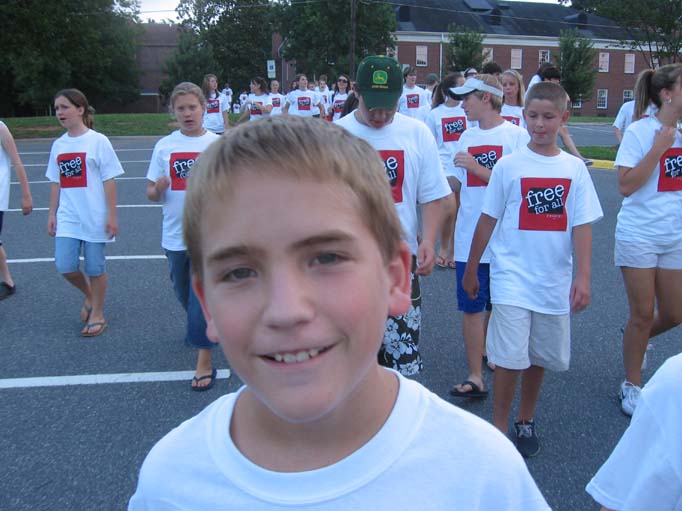
Here 18 of our students, along with about 250-300 from other churches, are enjoying a spiritual renewal week. This is a camp of being and doing. We spend time studying the Bible and then going out into the community serving in mission groups. The sponsors assist the students as they do their mission projects.

My group went to a local nursing home to visit with residents. The students made 4th of July Decorations for the doors, bused tables, and sang hymns. A few of the students actually knew the hymns. I had to teach them “The Cloudless Day,” complete with the edition from the 1954 Baptist Hymnal. The residents, of course, know the hymns by heart. I’m sure the students felt as awkward as some of the residents would have at a contemporary worship service, but we got along just fine and sang anyway.

The theme of this week’s Youth Camp, Free for All, was captured in a conversation that Carol McEntyre had with one of our students. The student was lamenting that she did not know what to do and was worried if the camp experience would turn out all right. Carol assured her, “Just be yourself,” and she responded with exasperation, “But I don’t know who I am!” Perhaps that’s what we’re all about this week.

Thursday, June 29, 2006

Great VBS Week

Parker at VBS

Parker at VBS

More VBS

More picts

VBS 2006


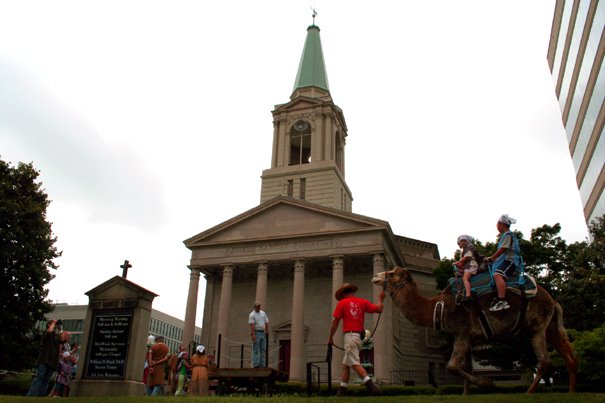
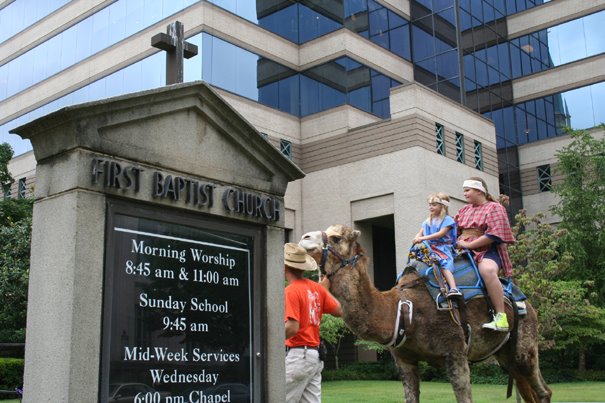
We're having a great week of Bible School at First Baptist-- complete with camel rides.

Monday, June 26, 2006

Missions: Experiences, Relationships, Lifestyle

USA Today says that Mission trips may do more harm than good. I'm sure that's the same argument people made before the idea of "partnership missions" became so popular. During the great missions movements of the 40 and 50s, people empowered individuals to leave churches and "Rescue the Perishing" in foreign lands. With the global village at our doorstep, we have grown in our understanding of missions. Everyone is a missionary. Each Christian has the apostolic call. Macedonia is Main Street.

Partnership missions or short-term mission trips have been the primary catalyst driving international service since the 1970s. We should distinguish between experiences, relationships, and lifestyle missions, however.

USA Today describes the dangers of experiential mission trips. These are designed to give individuals who have never been exposed to the problems of the world a chance to see it firsthand. It's hard to believe that Americans would not understand how impoverished other parts of the world are. No, it's really not hard to believe. Hence the reason for taking blessed Americans to places not nearly as blessed materially. These once in a lifetime experiences raise awareness and cause individuals to be more sensitive to needs in their homes. The downside is that some groups merely return with a great powerpoint show for their churches, and churches risk becoming God's travel agency, offering great discounts to faraway lands. The article fails to note, however, that most of the Katrina recovery process has been placed on the backs of churches and religious groups taking experiential trips. And they have risen to the challenge.

Relationship trips are ongoing ministry opportunities designed to do more than simply benefit the traveler. These collaborations take churches and groups to parts of the world that over the long haul, prove beneficial for both parties. Not only do you see the individuals in a particular place, but you see their lives (and yours) change. The risk of course is that the host becomes dependent on the visitor. The opportunity, however, goes far beyond the risks.

Third is the lifestyle of missions. This is the ultimate end of the journey, when a person sees her life as one called to a place, to serve a people, wherever the road takes her.

Sunday, June 25, 2006

Mission Trips-- Do they Work?

I'm a mission trip veteran. If mission trips had ranks, I'd at least be 2nd Lieutenant. I've swung more hammers, weed-whacked more yards, and enjoyed more Kool-Aid from yellow igloo coolers than I can count. But after all the work, do they do any good? A recent article in USA Today questions the value of short-term mission trips.

I'd like to explore this idea over the next few posts. First, the article....

"On a mission — a short-term mission"
Posted 6/18/2006

By G. Jeffrey MacDonald, Special for USA TODAY
As a single mother and elementary-school music teacher in Alamogordo, N.M., Cheryl Dockray usually umpires all the summer softball games she can to make ends meet.
But in early June, she took a rare week off — and worked even harder than usual. With eight other adults and 13 young people from Alamogordo's Grace United Methodist Church, she helped gut a New Orleans home that had been rotting in floodwaters for nine months.

"I can't give huge monetary donations, but I can give of myself and my time," Dockray says from Kenner, La., where the group was sleeping on air mattresses at a church.

Short-term mission trips (less than two weeks) are enjoying a wave of popularity with Americans eager to put faith into action and make vacations meaningful. About 1.6 million Americans took such trips abroad last year, according to a survey by Robert Wuthnow, Princeton University sociologist of religion. Domestic trips, which peak in the summer, are even more popular.

Popular as they are, critics say, short-term mission trips can be counterproductive — or worse. Concerns surface especially with international trips.

Judd Birdsall, former managing editor of The Review of Faith & International Affairs, a Christian journal, grew up in Japan in an evangelical missionary home. Too often these days, he says, untrained short-term missioners — or "vacationaries" — offend indigenous populations and undermine hard-earned relationships cultivated by long-term missionaries over many years.

"At this point, it really is an out-of-control phenomenon," Birdsall says. "Americans come in with good intentions, but they couple zeal with ignorance, and that can be a deadly combination for the folks who are on the ground slogging it out year after year."

All too often, groups set off with scant foreign-language skills and minimal cross-cultural training, says David Livermore, author of Serving with Eyes Wide Open. Their construction projects sometimes take work away from locals or come at the expense of more pressing needs, Livermore says, but impoverished hosts dare not protest.

"Often there's too high a price for them to say no to this because often (hosting a group) is the means to getting the check that will help support them."

Volunteers also run the risk of duplicating efforts in today's decentralized mission environment, says Mark Oestreicher of Youth Specialties, an El Cajon, Calif.-based training firm for church youth leaders. One slum in Tijuana, Mexico, for example, now expects regular visits from mission-driven groups from Southern California.

"Each of these groups will come in, do a vacation Bible school and lead the same kids to Christ over and over again," Oestreicher says.

Others concede that the trips aren't perfect but say they do a lot of good. Dana Robert of the Center for Global Christianity and Mission at Boston University points to improved standards of living and broadened perspectives of those who travel, interact and serve.

"A lot of people come back from these trips humbled," Robert says. "I think, on balance, it's more worthwhile than not."

This year, short-term missions are getting a prominent stage as thousands of teams focus on hurricane-damaged regions of the USA. For the first time since Katrina hit last August, volunteers this month are using every bed available from the Louisiana United Methodist Storm Recovery Center as 2,400 teams arrive in the New Orleans area.

Whether the destination is the Gulf Coast or the Persian Gulf, the Internet has made short-term mission trips relatively easy to arrange, says Todd Johnson of the Center for the Study of Global Christianity at Gordon-Conwell Theological Seminary in South Hamilton, Mass. He says fast-growing independent churches have "absolutely transformed" short-term missions over the past decade into an arena where congregations, rather than established agencies with a long-term presence in a region, define trips' goals and parameters.

Pamela Brown of Richmond, Va., says unmediated connections between religious communities help relationships flourish. When her Presbyterian (U.S.A.) church first established a direct tie with a local church and orphanage in Morelia, Mexico, in the late 1990s, "everything we did was fine with them because we left it a better place than we found it."

Based on this model, with "no red tape involved," her church now sends teams quarterly to Kazakhstan to help with dental care, management consulting and other humanitarian ministries.

Proponents of short-term missions generally agree that missionaries need cultural training to be effective, whether their goal is to alleviate physical suffering, win converts or both. The Alamogordo group opted to work within Methodist channels, which provide an orientation and prohibit proselytizing, because no one in the group knew the landscape or needs of New Orleans, says group leader Heath Husted.

For others, the days of seeking guidance from denominations or established agencies are a distant memory.

At the 4,000-member Word of Grace Church in Mesa, Ariz., regular mission trips to Central America, Africa and the Middle East rely on the church's own local connections and in-house training.

"We're not dependent on an agency. ... We don't have a middleman," says the Rev. Andy Jackson, pastor of discipleship and leadership development. "Just because a group calls itself a mission agency, that doesn't mean it provides good quality control."

Sunday, June 18, 2006

Farewell to an Old Friend


The most significant news in Baptist life in Knoxville last week was not the election of a new president of the Southern Baptist Convention. We’re pretty removed from politics now at 510 W Main. The most significant story ran the same day in the local paper. Baptist Hospital is being sold.

Baptists have never been very good at parting ways with their institutions. Like an overprotective parent, we keep a pretty tight rein on our hospitals, universities, and children’s homes. When the rumors started circulating late last year that our old friend Baptist Hospital was officially on the market, the First Baptist family felt a collective sense of loss. East Tennessee’s Baptist Hospital would not exist were it not for Fred Brown and the leadership of First Baptist. Some have even said that Dr. Brown announced in the pulpit of FBC that they needed more money for the hospital and passed the plate until he collected enough. Over the years, First Baptist members have had a strong presence on the board and given time and money to make it possible for everyone to have access to healthcare.

With this week’s news of Triad Health System’s purchase of our baby, we say farewell to an old friend. Long ago, Tennessee Baptists removed themselves from positions of monetary influence. As healthcare costs soared, Tennessee Baptists contributions did not. That’s life today, and we’ve seen this story repeated around the country as various Baptist institutions have grown up and moved on. We have church members today that serve on the board and as employees in each of the healthcare systems in Knoxville. It’s truly a new day in healthcare.

The board and employees of Baptist have been in my prayers the past months. Each person knows the agony of the decision at a personal and private level. We have seen good church members relocate; we have encouraged board members who have made tough, difficult decisions. We will walk beside each person as they face inevitable transitions in the coming days and hopefully welcome new members who are part of Triad’s group.

Several lessons can be learned as people of First Baptist.

(1) The Baptist name is still popular in some circles. Ironically, one of the things Triad wanted to maintain is the name. Isn’t it interesting that the only area where Baptists get good reviews is in healthcare? This should be a lesson to all of us. Baptists as a brand and as a people are at their best when they minister to people in the crisis moments in the name of Christ.
(2) We can still have a prophetic voice. The News-Sentinel’s editorial alluded to a looming crisis if charity cases are not covered in the new system. UT and St. Mary’s can’t do it alone. We need to refocus our efforts to caring for those who cannot afford the benefits that most of us take for granted. We must accomplish this beyond pious rhetoric. Our wallets and actions must match our words.
(3) Institutions grow and change. We should apply the principles of the Baptist experience to Belmont, Carson-Newman, and other institutions. We should allow them freedom to be the best they can be, raise money from as many sources as possible, and help them maintain a Baptist identity in the best sense of the word.
(4) We will always be there for Baptist. First Baptist will continue to send employees and volunteers across the river and out west. Baptists are everywhere. Let’s welcome our new friends, encourage those who remain, and pray for people who will seek new employment.

Farewell, old friend, East Tennessee Baptist Hospital. May the new Baptist carry on the legacy that we have built together.

Saturday, June 17, 2006

No Left Turns-- Something for Father's Day

Michael Gartner wrote a great Father's Day tribute in this weekend's USA Today. Enjoy.
"A Life Without Left Turns"
Michael Gartner

My father never drove a car.
Well, that's not quite right.

I should say I never saw him drive a car. He quit driving in 1927, when he was 25 years old, and the last car he drove was a 1926 Whippet.

"In those days," he told me when he was in his 90s, "to drive a car you had to do things with your hands, and do things with your feet, and look every which way, and I decided you could walk through life and enjoy it or drive through life and miss it."

At which point my mother, a sometimes salty Irishwoman, chimed in:

"Oh, bull——!" she said. "He hit a horse."

"Well," my father said, "there was that, too."

So my brother and I grew up in a household without a car. The neighbors all had cars — the Kollingses next door had a green 1941 Dodge, the VanLaninghams across the street a gray 1936 Plymouth, the Hopsons two doors down a black 1941 Ford — but we had none. My father, a newspaperman in Des Moines, would take the streetcar to work and, often as not, walk the 3 miles home. If he took the streetcar home, my mother and brother and I would walk the three blocks to the streetcar stop, meet him and walk home together.

Our 1950 Chevy

My brother, David, was born in 1935, and I was born in 1938, and sometimes, at dinner, we'd ask how come all the neighbors had cars but we had none. "No one in the family drives," my mother would explain, and that was that. But, sometimes, my father would say, "But as soon as one of you boys turns 16, we'll get one."

It was as if he wasn't sure which one of us would turn 16 first.

But, sure enough, my brother turned 16 before I did, so in 1951 my parents bought a used 1950 Chevrolet from a friend who ran the parts department at a Chevy dealership downtown. It was a four-door, white model, stick shift, fender skirts, loaded with everything, and, since my parents didn't drive, it more or less became my brother's car.

Having a car but not being able to drive didn't bother my father, but it didn't make sense to my mother. So in 1952, when she was 43 years old, she asked a friend to teach her to drive. She learned in a nearby cemetery, the place where I learned to drive the following year and where, a generation later, I took my two sons to practice driving. The cemetery probably was my father's idea. "Who can your mother hurt in the cemetery?" I remember him saying once.

For the next 45 years or so, until she was 90, my mother was the driver in the family. Neither she nor my father had any sense of direction, but he loaded up on maps — though they seldom left the city limits — and appointed himself navigator. It seemed to work.

The ritual walk to church

Still, they both continued to walk a lot. My mother was a devout Catholic, and my father an equally devout agnostic, an arrangement that didn't seem to bother either of them through their 75 years of marriage. (Yes, 75 years, and they were deeply in love the entire time.) He retired when he was 70, and nearly every morning for the next 20 years or so, he would walk with her the mile to St. Augustin's Church. She would walk down and sit in the front pew, and he would wait in the back until he saw which of the parish's two priests was on duty that morning. If it was the pastor, my father then would go out and take a 2-mile walk, meeting my mother at the end of the service and walking her home. If it was the assistant pastor, he'd take just a 1-mile walk and then head back to the church.

He called the priests "Father Fast" and "Father Slow."

After he retired, my father almost always accompanied my mother whenever she drove anywhere, even if he had no reason to go along. If she were going to the beauty parlor, he'd sit in the car and read, or go take a stroll or, if it was summer, have her keep the engine running so he could listen to the Cubs game on the radio. (In the evening, then, when I'd stop by, he'd explain: "The Cubs lost again. The millionaire on second base made a bad throw to the millionaire on first base, so the multimillionaire on third base scored.") If she were going to the grocery store, he would go along to carry the bags out — and to make sure she loaded up on ice cream.

As I said, he was always the navigator, and once, when he was 95 and she was 88 and still driving, he said to me, "Do you want to know the secret of a long life?" "I guess so," I said, knowing it probably would be something bizarre.

"No left turns," he said.

"What?" I asked.

"No left turns," he repeated. "Several years ago, your mother and I read an article that said most accidents that old people are in happen when they turn left in front of oncoming traffic. As you get older, your eyesight worsens, and you can lose your depth perception, it said. So your mother and I decided never again to make a left turn."

"What?" I said again. "No left turns," he said. "Think about it. Three rights are the same as a left, and that's a lot safer. So we always make three rights."

"You're kidding!" I said, and I turned to my mother for support. "No," she said, "your father is right. We make three rights. It works."

But then she added: "Except when your father loses count."

I was driving at the time, and I almost drove off the road as I started laughing. "Loses count?" I asked. "Yes," my father admitted, "that sometimes happens. But it's not a problem. You just make seven rights, and you're okay again."

I couldn't resist. "Do you ever go for 11?" I asked.

"No," he said. "If we miss it at seven, we just come home and call it a bad day. Besides, nothing in life is so important it can't be put off another day or another week."

My mother was never in an accident, but one evening she handed me her car keys and said she had decided to quit driving. That was in 1999, when she was 90. She lived four more years, until 2003. My father died the next year, at 102. They both died in the bungalow they had moved into in 1937 and bought a few years later for $3,000. (Sixty years later, my brother and I paid $8,000 to have a shower put in the tiny bathroom — the house had never had one. My father would have died then and there if he knew the shower cost nearly three times what he paid for the house.) He continued to walk daily — he had me get him a treadmill when he was 101 because he was afraid he'd fall on the icy sidewalks but wanted to keep exercising — and he was of sound mind and sound body until the moment he died.

A happy life

One September afternoon in 2004, he and my son went with me when I had to give a talk in a neighboring town, and it was clear to all three of us that he was wearing out, though we had the usual wide-ranging conversation about politics and newspapers and things in the news. A few weeks earlier, he had told my son, "You know, Mike, the first hundred years are a lot easier than the second hundred." At one point in our drive that Saturday, he said, "You know, I'm probably not going to live much longer." "You're probably right," I said. "Why would you say that?" he countered, somewhat irritated. "Because you're 102 years old," I said. "Yes," he said, "you're right." He stayed in bed all the next day. That night, I suggested to my son and daughter that we sit up with him through the night. He appreciated it, he said, though at one point, apparently seeing us look gloomy, he said: "I would like to make an announcement. No one in this room is dead yet." An hour or so later, he spoke his last words:

"I want you to know," he said, clearly and lucidly, "that I am in no pain. I am very comfortable. And I have had as happy a life as anyone on this earth could ever have."

A short time later, he died.

I miss him a lot, and I think about him a lot. I've wondered now and then how it was that my family and I were so lucky that he lived so long.

I can't figure out if it was because he walked through life.

Or because he quit taking left turns.

Michael Gartner has been editor of newspapers large and small and president of NBC News. In 1997, he won the Pulitzer Prize for editorial writing.

Wednesday, June 14, 2006

Thanking Public School Educators

On Monday, several East Tennessee Baptist churches published an advertisement in the Knoxville News-Sentinel. To view the ad, click on this link. Thanks, educators.

To view other resources for Baptists who support public schools, visit Ethicsdaily.com.

Does a New President of the SBC Really Matter?

Amidst all the things going on in our world today: a new hurricane season, ministering to immigrants, and handling the Iraq issues, the Southern Baptists made headlines again.

In our annual 2nd week in June pilgrimage to a Civic Center near you, the SBC voted for a hometown guy to be the president. A native of Greensboro, Frank Page squeaked by with some home cookin' and some local voters.

What made this so interesting to the New York Times and even local news here in Knoxville is this guy is not one of "the boys." He wasn't hand-picked in a back room. He was voted on by the people.

Here's the real story. Dr. Frank Page is the SBC's first blogging president. A pastor in Oklahoma used his blog to run Frank Page's campaign. The big stink over Dr. Page among the other candidates is not only his age (he's a young buck-- 51), but also he supports only the Baptist Faith and Message 2000. This is the new document voted on by the SBC to replace their old confession of 1963. (My church still adheres to the 1963 document, not the 2000.) But the 2000 is the criteria for hiring in the new SBC. Lately, the International Mission Board has been in a tailspin because some of their missionaries who want to pray as they feel led. The International Mission Board trustees have been debating whether or not it's ok for their missionaries to pray in tongues. I'm not kidding; this is the stuff they debate in board rooms. And of course, prayer or the said language in which one prays is not covered in the 2000 Baptist Faith and Message. So.... Dr. Page is in the camp of "let 'em pray as they feel led." Or in other words, don't go beyond the hiring document that they already have.

If this is confusing to you, it should be. While the rest of the South waits for more hurricanes, we're debating who and how people should be praying. Baptists are fiercely independent, and they really don't like to be told how to pray.

So...good luck to Dr. Page as he sorts things out in the prayer closet. As for me, I'm going to try to stay focused on sharing Christ's love with the people affected by paragraph 1. I'm sure we don't need a vote or a blog to do it. And these are the things that really matter.

Sunday, June 11, 2006

Money Talks

One of the best kept secrets about First Baptist Knoxville has been our Pastoral Counselor who has been here for nearly 30 years. He writes a regular column on my church's website entitled, "Money Talks." Here's his latest entry. To read more, go to the Money Talks link on my church website.

Differences are Attractive but Difficult

Differences are so attractive but they are so difficult. Relationships are often created by differences. Those same differences challenge, divide, and test us. For example, in marriage, marital researchers convince us that differences attract. When we look for a marital partner, we do not look for someone like us. We look for someone to complete us.

Sydnor and I often talk about our differences and how they attracted us to one another. For example, Sydnor grew up at 1423 Madison Avenue. I grew up on Route 3. Sydnor grew up with two siblings. I grew up with eight. Sydnor grew up with much travel. I traveled to two other states—Georgia five miles away, and Florida, 80 miles away—till I was 20 years of age. Sydnor grew up with the expectation to finish college. I grew up with the expectation to finish high school. Sydnor grew up with banking. I grew up with farming.

The major difference that attracted me to Sydnor was that she was extroverted and comfortable with people. When I met her, I was looking for a wife. I was also looking for a wife that would compliment my call and profession. I needed her social skills. Her skills would make up for mine. And I married well!

That difference showed up on our marital screen when we moved back to South Carolina, to Darlington, which was only ten miles away from her hometown of Florence. Suddenly we were invited to many parties, many weddings, many family occasions; and my social appetite, that ate sparingly, was being overly fed. I found myself resenting the very piece that I needed and liked most about her.

Differences are a gift but at the same time they require hard work. Dealing with relational differences has been one of the defining issues of the church since Jesus created her. Over against his own heritage, Jesus created one of the most diverse communities imaginable. It was a community made up of Jews, Samaritans, and Gentiles. Those differences that Jesus sought to build into the tapestry of his New Kingdom became the very core of Paul’s teaching and ministry. They challenged the early church and eventually defined it.

What we do with differences, whether church or marriage, will have much to do with both who we are and who we become. Enjoy the gift but work hard!

Friday, June 09, 2006

Between 11/9 and 9/11 (Last post on Baptists of the Future)

Conclusion
In May 1989, 6 months before the fall of the Berlin Wall, Dayna Curry graduated from high school to attend Baylor University. This generation X-er attending a Baptist school would have been the average girl next door, except she felt God’s call to service and missions. She did not go through the standard boards or agencies. She volunteered with Shelter Now International, a German relief group. She and her friend Heather Mercer were caught in the crossfire of 9/11. They were missionaries to the Taliban in Afghanistan when the United States invaded.

What drives these women to serve? As we discover from Generations X and Y, this is part of their culture. They represent the generations of the future for Baptists. They are living between 11/9 and 9/11.

Thursday, June 08, 2006

More Implications

3.) Expect more. These generations volunteered to be missionaries among the Taliban and fight in Afghanistan and Iraq. They will do the unthinkable; it might as well be through your organization.

4.) Collaborate with parachurch ministries. Church is one of many spiritual vendors in society. Young Life, Campus Crusade, etc., are all part of the spiritual formation of these students. Don’t resist it; affirm it. Buy into it; work with these organizations. Learn from them, and build community with them.

In a recent article on youth ministry, The New York Times suggested that students are going to one church for worship, another church or parachurch for Bible study, and another to assist in the community. I anticipate this trend to carry into adulthood. If you are not the worship place for students, provide another way to connect with them.

5.) Release control. One thing we’re learning is that these students not only want to attend worship, they desire to own the experience. If it is right for your context, start a service to reach this generation. If it is not, know that many in this generation will appreciate the ancient traditions of the faith if they connect with you and own part of the church. We cannot expect this group to be a part of something they have little input into. They need to feel ownership in the church and its ministries. It’s not about style, it’s about ownership and authenticity.

6.) Be the faith family for these generations. Multigenerations are back. Community is important. One college student said, “Be the community I never had at home.” Where Willow Creek and Saddleback pioneered niche market churches, now young people want to connect with spiritual grandparents. Pair senior adults with college students for mission projects. Create opportunities for mentoring and service. Adopt a college student, share life, and learn from each other.

Saturday, June 03, 2006

Future of Baptists-- Implications

One part of our future as Baptists relates to how we will work with other churches. Here's one example from our context in Knoxville. This recent article in Knoxville Magazine tells the story better than I can.

Thursday, June 01, 2006

Baptists of the Future-- Implications

Implications for Church Ministry
Because most Baptists are members of institutional churches, we are affected by these trends and should take note of several things that affect us as we move forward.
1.) Keep it real. The best advice that I continue to hear from younger people is whatever you do, be authentic. Ministers should have face time with these generations. Go to Starbucks. Hang out. Be accessible. Give your current students a safe place now to ask tough questions. Martinson says that one of the key factors in students' returning to church is that they had a safe place in young adulthood to ask questions and a place where they could come “home.”

2.) Give opportunities to serve. Service is an entry point to the church. We saw this especially during our Hurricane Katrina relief efforts. We had volunteers from UT who had never been to worship or Sunday School.

Google Search

Google